Instant intake
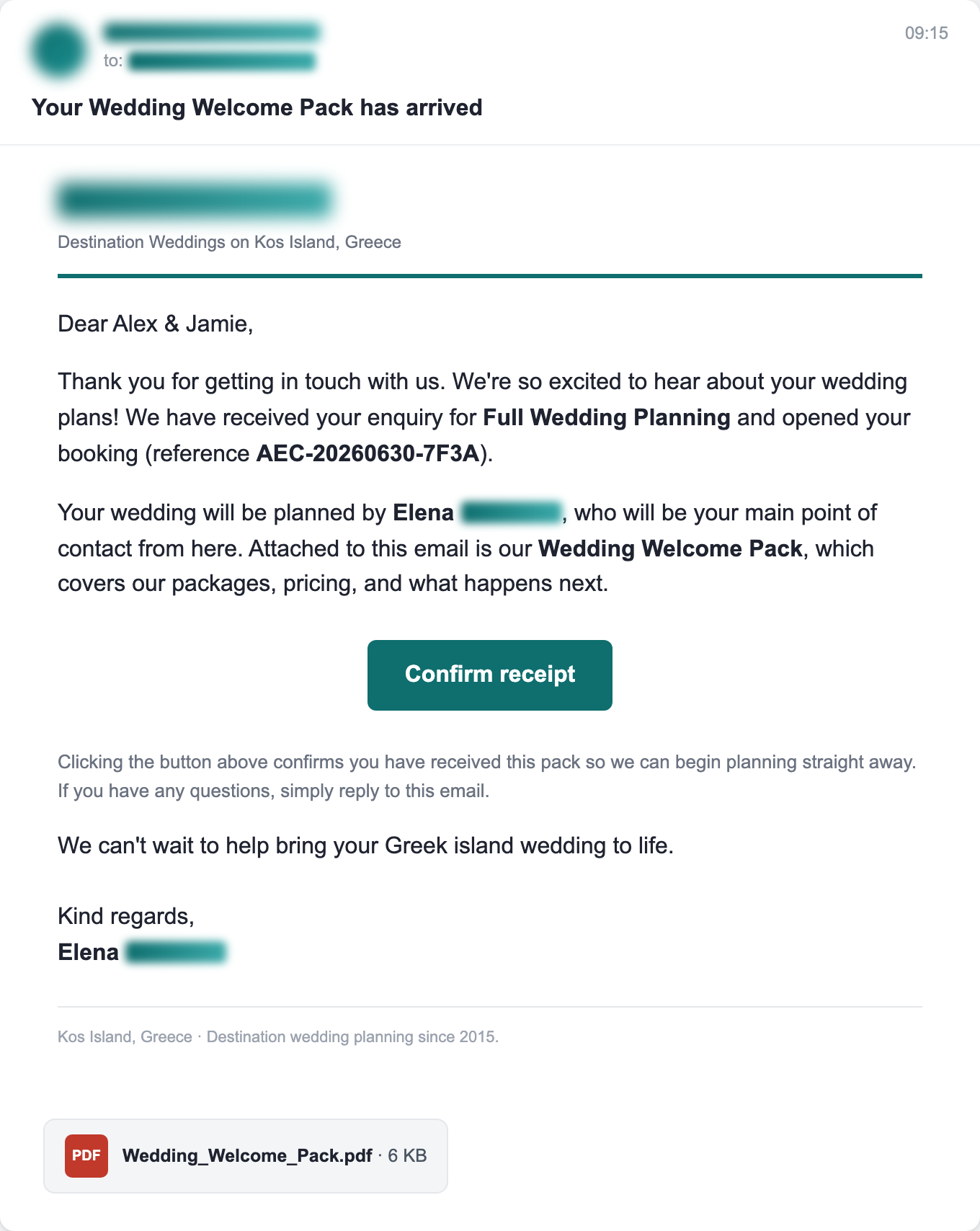
The moment the form is submitted, a nested Drive folder, a new tracker row and a welcome email with the wedding pack attached are all in place before the couple has closed the tab.
Operations Automation · Hospitality & Events
A boutique destination-wedding planner on Kos Island was losing bookings before a single planning call happened — not from a lack of couples enquiring, but from how long it took to get back to them. We built an automation that answers, organises and follows up the moment an enquiry lands, in under an hour instead of three days.
The Problem
A new enquiry arrived the same way it always had: through the website contact form or a DM. Someone copied the details into a notes app. A team member created a folder on Google Drive, copied the details into a shared spreadsheet, and emailed a welcome pack — packages and pricing — when they remembered to.
Destination-wedding couples don't enquire with one planner. They enquire with two or three, at the same time, and book with whoever replies fastest and most professionally. By the time the team followed up, 30% of couples had already booked elsewhere. Their own calculation: 3.5 hours of admin per enquiry, spread across three people, before a single planning call ever happened.
Before
The Solution
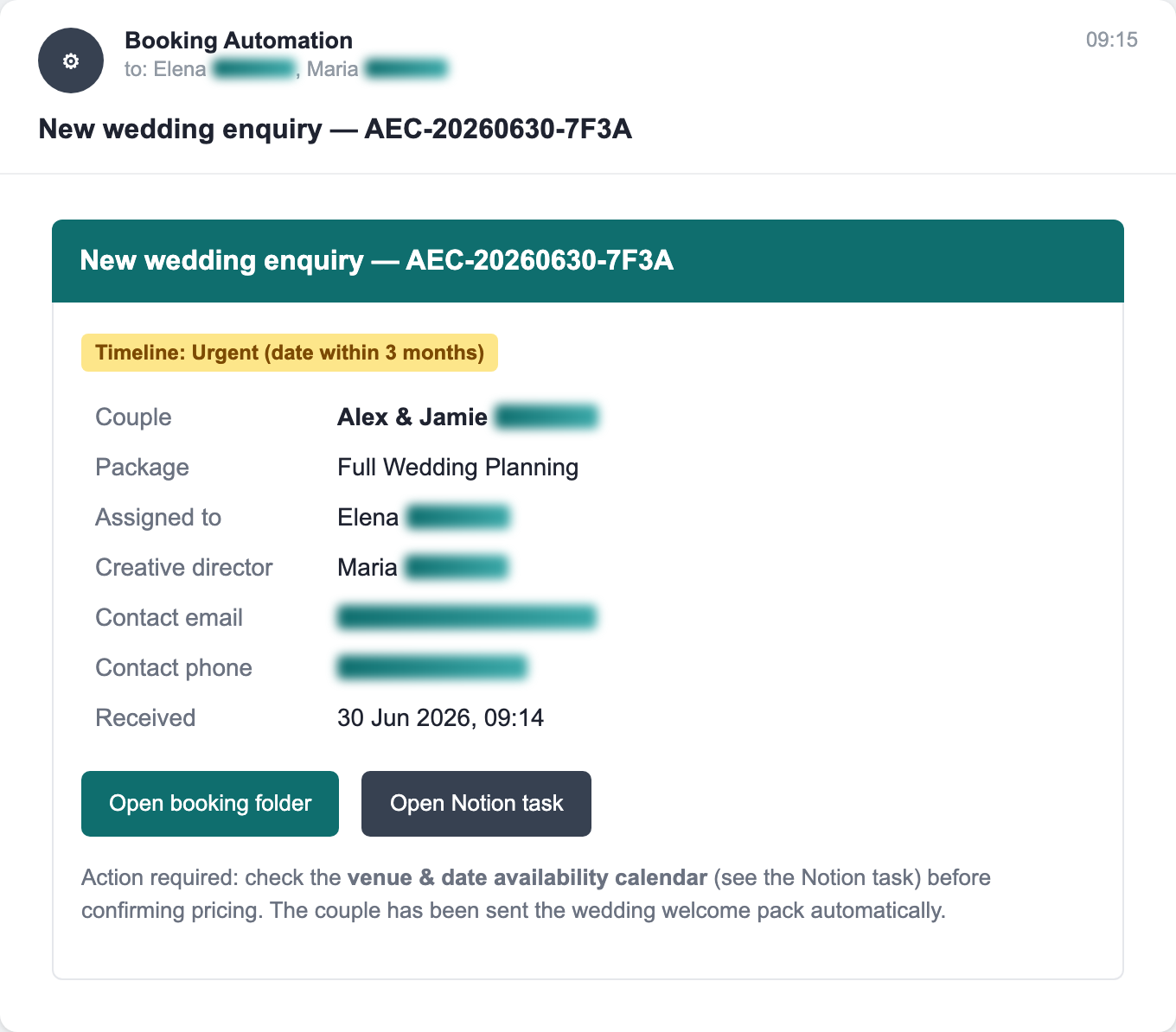
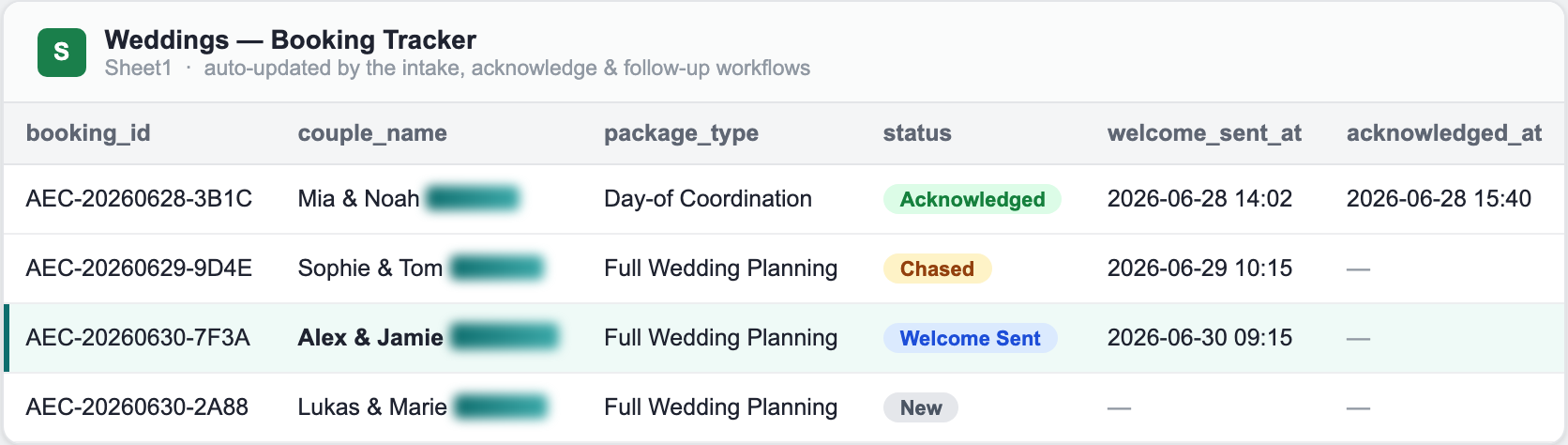
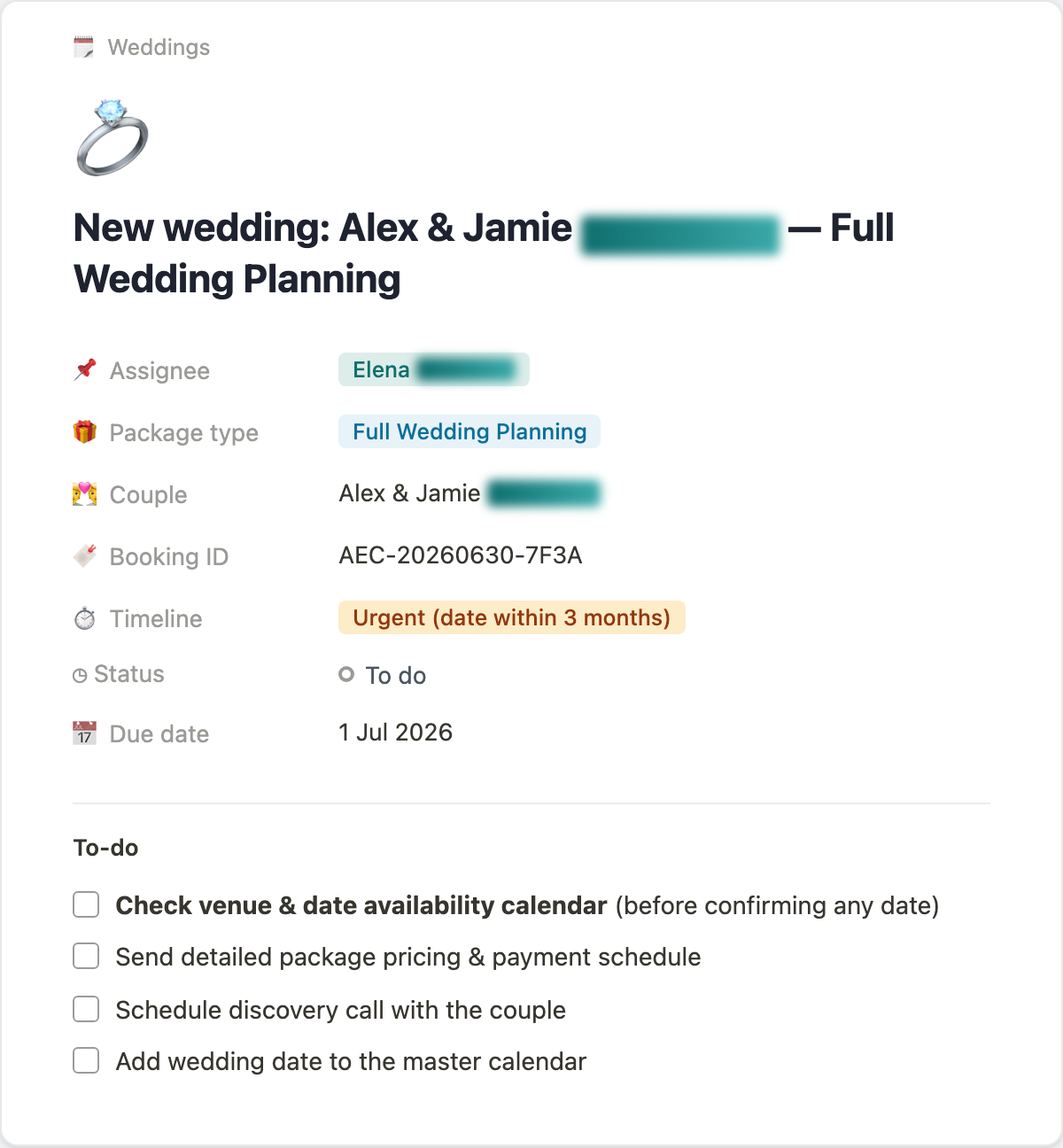
We built an automation that fires the instant a couple submits the enquiry form. It creates the booking folder, logs the enquiry, sends a personalised welcome pack by email, opens a task for the assigned planner with a ready-made checklist, and alerts the creative director on duty — all within about a minute, with nobody at a desk needing to do any of it.
If the couple hasn't confirmed receipt within 48 hours, one chase email goes out automatically, without anyone needing to remember.
The moment the form is submitted, a nested Drive folder, a new tracker row and a welcome email with the wedding pack attached are all in place before the couple has closed the tab.
Every booking creates a task for the assigned planner with a ready-made checklist — check availability, send pricing, book the call, update the calendar — plus an instant email to the creative director on duty.
An hourly check reads the tracker and chases any couple who hasn't confirmed receipt after 48 hours, exactly once, so no enquiry goes quiet just because someone forgot.
In practice
How we solved it
Days before the build started, Microsoft retired the free webhook connector the planned staff-alert channel depended on — the only replacement needs a paid work licence. We rerouted staff alerts through email instead: the same couple, package, timeline and task details, landing in an inbox every planner already checks, at no extra cost.
The free hosting tier wipes its disk on every restart, and the cloud-drive credential meant to serve the welcome pack had already expired. We embedded the pack directly inside the automation's own code as data, so sending it never depends on fetching a file from anywhere else.
Holding a 48-hour countdown open in memory doesn't survive a free-tier server that goes to sleep after 15 minutes of inactivity. Instead, an hourly check reads the tracker and chases anyone still unconfirmed — restart-safe, because it never has anything to remember between checks.
The task board's people-picker only understands invited workspace members mapped by internal ID — unnecessary setup for a simple hand-off. The planner's name is a plain field instead: it shows up immediately, needs no invitations, and can be upgraded later if the team grows into the tool full-time.
The Outcome
Before
After
If you're losing enquiries to response delays, we can fix that. Book a free audit and we'll show you exactly what's possible.
Book a free auditLet's get started
 Cube86
We design and build operating systems for ambitious teams. Operations, automation and AI — done with you, not just for you.
© 2026 Cube86. All rights reserved.
Built in London. Working globally.